Authentically You by Mia Bukow

Introduction

Before We Start

Hi. I'm Mia.

I've always been the person who notices a room. As a kid, I would move furniture because a corner bothered me, redo a shelf just to see if it felt better, and turn school projects into visual projects whenever I could. I didn't know words like neuroaesthetics. I just knew some spaces made me want to stay, think, or make things, and some didn't.

The noticing turned into something more useful the year I turned eight. My parents divorced that year. I did not know how to handle it. I was eight, nobody hands you instructions, and I did not have words for most of what I was feeling. I could not fix it, and I could not make it go away. What I had, at my mom's new place, was a storage closet under the stairs that nobody was using. I claimed it, turned it into my playroom, and poured everything into it. I decided what color I wanted to see first, where the desk went, and which of my drawings made the cut. I could not control what was happening to my family, but I could control that, and I held onto it. Fixing up that closet was the first time I understood that a space could make a hard stretch feel a little steadier. My family called it my Harry Potter room, and you will hear more about it in Chapter 11.

Middle school is where the other half of this book comes from. In seventh grade I came back to school in person after a long stretch of online classes, wearing a back brace for scoliosis. It was big, it was hard plastic, and it went everywhere I went. I spent most of that year trying to hide it. I wore oversized sweatshirts on purpose, kept my opinions small, and worked hard at looking like everyone else, because I was convinced that if anyone noticed the brace, it would be the only thing they saw. I wanted a new friend to learn my name before learning about my spine. Some of that year was rougher than belongs in a design book. What I can tell you is that blending in was exhausting, it never made me feel any safer, and it taught me something I still believe: wanting to be known for who you are is not the same thing as wanting attention.

Some parts of those years belong to people I love, and some are stories I may tell later, or may keep to myself. I get to decide that, and so do you. I keep coming back to that idea in this book, and I figured I should practice it.

When I stopped spending all my attention on fitting in, I finally had some left over for figuring out what I liked. I liked color and light. I liked objects with a story behind them, a desk I could focus at, and clothes I didn't have to adjust all day.

As I got older, I started asking why. Why can one room make homework feel easier while another makes your brain feel loud? Why can an outfit change the way you carry yourself? I started testing little changes, paying attention to what happened, and then reading everything I could find about the questions that kept coming up.

I'm 17. This book isn't coming from a huge portfolio or a client list, and I don't want to pretend it is. It comes from experimenting with my own spaces and projects, helping friends and family, spending time behind the scenes in an interior design office, and spending a lot of time researching how environments can affect the way we feel and function.

That's where this book came from.

If you are having a hard year right now, I want you to know something I didn't know in seventh grade: you can start with your room.

I'm not going to tell you the correct shade of white for your walls or which throw pillows you need. There are a million places online for that. I care more about the question underneath all of it: what feels like you? Not what keeps showing up on TikTok, not what your parents would choose, and not what looks right in somebody else's room. Once you know that, your room, clothes, desk, and even little daily routines get easier to make your own.

I don't think your surroundings are something you have to earn after you've figured out your life. You can use what you have right now to make everyday life feel more supportive, more personal, and more yours.

A room can't build your life for you. It can't get you into college, fix a bad day, or magically make you confident. But it can make it easier to focus, rest, create, get ready, have a friend over, or just feel comfortable being yourself.

It's kind of weird how specific we can be about a playlist and how little thought we give the room where we listen to it. We know exactly which song belongs on a getting-ready playlist, but we can live with the same wall, light, or chair for years and never ask whether we even like it. That made me wonder what would happen if we paid a little more attention to the physical world around us.

I started going down research rabbit holes. I read studies, books, and articles about environmental psychology, neuroaesthetics, color, light, clutter, nature, sensory needs, identity, and clothing. Then I tried ideas in my own room and helped friends and family think through theirs. Some things worked, some didn't, and some surprised me. This book is what I wish I'd had when I first started trying to connect all of that.

My business is called Room2Flourish, and the name means two things.

The first is the obvious one: a room you can flourish in. That means a space set up for the person who lives in it, so it helps you sleep, focus, make things, and have people over instead of working against you all day.

The second meaning is making room. You are probably carrying something around. It might be a rough year, a friendship that ended badly, the person you had to be to get through middle school, or somebody's opinion about what you are allowed to like. Cleaning your desk won't erase any of that. But the more of it you stop hauling everywhere, the more room you get. You get room in your head, room in your day, and room in your life for things that are new and yours. The question is what you do with the room that opens up. My answer is to fill it with you, with your own colors, objects, and ideas.

Part One is about noticing what your surroundings are already doing. Part Two introduces the 12 Design Archetypes, the framework I created to make design identity easier to understand. Part Three takes that idea into twelve parts of daily life. Part Four is about starting before you have a perfect room or a perfect budget.

If you are in a hurry because you are moving into a dorm or an apartment with friends soon, read Chapters 7, 8, 9, and 11 first. Chapters 7 and 8 help you figure out your design identity before you buy anything, so your first shopping trip is not just a copy of somebody's dorm checklist. Chapter 9 tells the story of Priya and Alex, two roommates with very different styles who have to make one apartment work for both of them. Chapter 11 is about the room you are moving into, including dorms and rentals where you cannot paint the walls. Then come back and read the rest once you have unpacked.

A giant budget or perfect space isn't required.

You do need to pay attention to what feels like you and what doesn't.

Let's figure that out.

Mia
Part One

The Wake Up

Why Everything Around You Matters More Than You Think

Chapter 1

Your Room Is Talking to You (You're Just Not Listening)

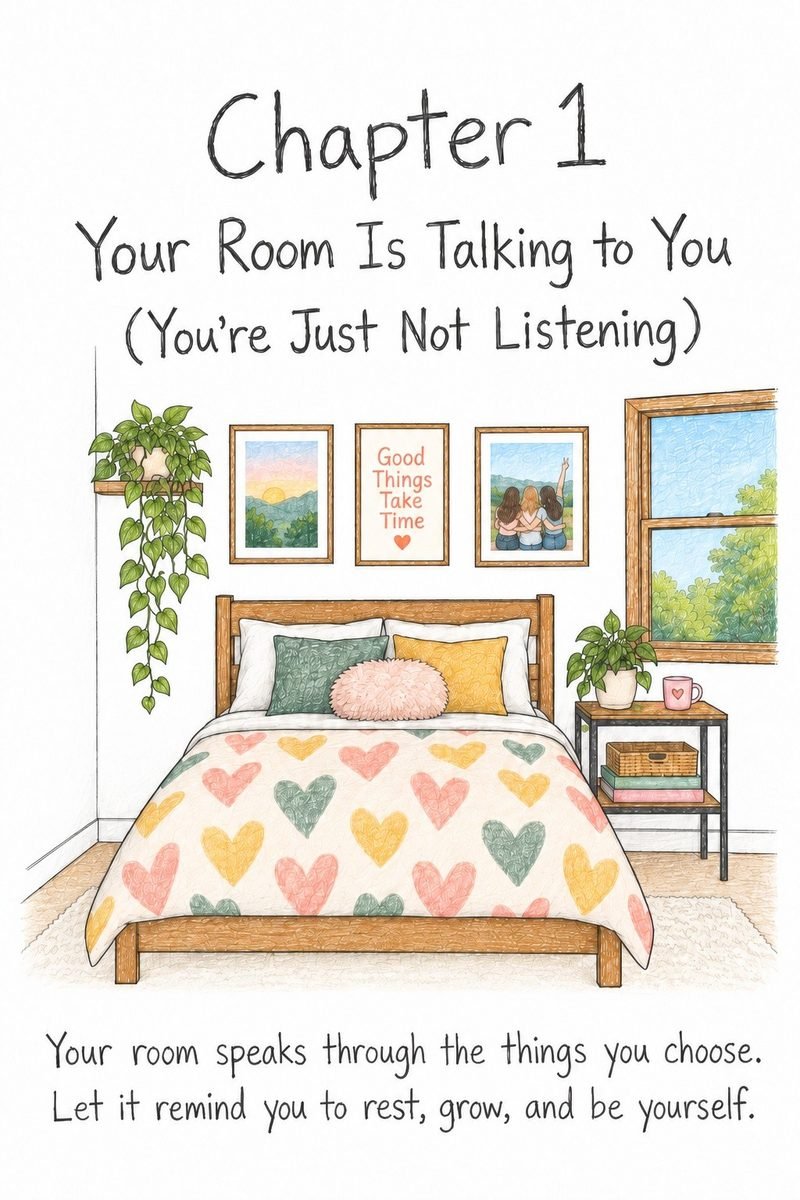
Chapter 1: Your Room Is Talking to You (You're Just Not Listening) chapter card

"Your room doesn't have to look perfect. It should feel good to live in."

Right now, wherever you're reading this, look up. Look around. What do you see?

Maybe it's a bedroom with clothes on the floor and a poster you stopped liking two years ago. Maybe it's a dorm room where half the furniture was chosen by the school. Maybe it's a first apartment you share with roommates, or just the same bedroom you've had since middle school. Maybe your desk is three feet from your bed and currently buried under chargers, water bottles, and homework.

Now ask yourself: does this space feel like me?

If you hesitated, that's your answer.

• • •

One reason spaces matter is simple: your brain is constantly taking in what is around you, even when you're not deliberately thinking about it. Light, noise, clutter, color, temperature, texture, and where things are placed all become part of the experience of being in a room.

I started reading about this because I wanted to know whether "this room feels better" was just personal taste. The answer is more interesting than that. Researchers in fields like environmental psychology and neuroaesthetics study how surroundings interact with attention, emotion, memory, stress, and behavior.

A messy desk does not automatically cause stress, and painting a wall blue will not fix your mood. People and environments are more complicated than that. Research does suggest that features of our surroundings can make it easier or harder to focus, settle down, restore our attention, or feel comfortable in a space.

I see this in myself. When my room gets chaotic, I feel more scattered. When I fix the lighting, clear enough space to work, or move something that has been bothering me, I usually feel the difference. Friends have described the same thing. The room isn't the whole problem, but sometimes it is one piece of it.

Changing a room won't solve everything. Sometimes it just removes one layer of friction. That still counts.

• • •

You Didn't Choose This. That's the Problem.

A lot of us live in spaces we didn't really choose. Your parents picked the furniture. You inherited a sibling's desk. Your dorm came with a bed, a dresser, and lighting that seems personally offended by happiness. You grabbed whatever was affordable because you needed something, and whether it felt like you never came up.

And then we get used to it. We stop asking a pretty basic question: what would make this space work better for me?

Meanwhile, we're incredibly specific about other things. We curate playlists down to the mood. We choose profile pictures carefully. We can spend forever getting one tiny online detail right. But the physical space where we sleep, study, get dressed, and recover from the day? A lot of the time we just accept whatever is there.

You would never let someone else choose every song you listen to. Your room deserves at least some of that same attention.

You also don't have to spend a fortune. Moving a lamp, clearing one surface, changing what you see from bed, putting something meaningful where you'll see it, or getting rid of something you secretly hate can matter. This is not about making the room expensive. It is about figuring out what helps and what gets in your way.

• • •

The Science of Why This Matters

I'm not going to turn this into a textbook, but the research is worth knowing because it changed how I thought about design.

The research is not as simple as "blue makes everyone calm" or "clutter makes everyone stressed." People respond differently, and context matters. But I kept seeing the same basic idea across the research: daylight, noise, visual clutter, nature, color, and sensory load can all affect how comfortable, distracted, restored, alert, or overwhelmed we feel in a space.

Clothing can matter too. You may see the term enclothed cognition, which researchers use when studying how what we wear can affect thoughts, attention, or behavior. One early lab-coat study became famous, but no single study proves that an outfit transforms your brain. What I take from the research is much simpler: what you wear can change how you see yourself in a moment, and that can affect how you act or feel.

That is why I think design deserves more respect than "making things pretty." Your surroundings are part of your day, and they do a lot more than decorate it.

If you're trying to study in the same sweatpants you've been wearing since yesterday, your phone is flashing every thirty seconds, there are three empty cups on the desk, and the overhead light makes everything look like a hospital waiting room, you can probably still get the assignment done. I've definitely done it.

"I can technically function here" is a pretty low bar.

I'd rather make the space help a little.

• • •

Design Is Already Happening to You

Once I started noticing design, I saw it everywhere.

Stores choose lighting, music, displays, and even where you walk for a reason. Restaurants think about sound, seating, color, and how long they want people to stay. Apps are designed to hold your attention. There are entire teams whose job is to think about how spaces and interfaces affect what we do.

I notice it in waiting rooms too. I have sat in a lot of them, and the ones with real daylight, a few plants, and art that somebody chose on purpose feel nothing like the ones with a buzzing light and a stack of old magazines, even when the wait is exactly as long. Somebody designed both of those rooms. Only one of them was designed with the person in the chair in mind.

Your own room is one of the few places where you get to use those choices for yourself. Even if you can't paint the walls or buy new furniture, you still have more control than you probably think.

So why not use some of it?

Forget the perfect aesthetic. Make the space work better for the person who lives there.

• • •

The Three Things Your Space Is Telling You Right Now

Try this. Look around the room you're in and answer three questions:

One: Is there anything here that makes me genuinely happy when I see it? Something I picked because I love it, not because it was cheap, trendy, or already there?

Two: Is there anything that belongs to an older version of me? An old poster, a gift I keep out of guilt, clothes I don't wear, something from a phase that ended a while ago?

Three: If I came into this room after a terrible day, would it help me feel better or make everything feel louder?

If one of those answers makes you pause, good. That's information. Redoing the whole room can wait. You've already found one place worth paying attention to.

I've seen small versions of this in my own room and when helping people I know. Moving furniture does not create a new life. But a space that works better can make it easier to study, sleep, get ready, make something, invite a friend over, or calm down after a long day. Those small things add up because you live with them every day.

• • •

So What Do We Do About It?

That's what the rest of this book is for.

I'm going to give you a framework for understanding your design identity, because it is hard to make a space feel like you if you have never stopped to ask what you like and need. Then we'll take that idea into twelve different parts of daily life and turn it into things you can try, even if your budget is zero.

Before we get there, I want to go backward for a minute. Before Pinterest boards, TikTok room tours, and having an opinion about whether something is "aesthetic."

Back to when you were a kid and liking something was usually enough of a reason to like it.

There are clues there.

Chapter 2

Remember Who You Were Before Everyone Had an Opinion

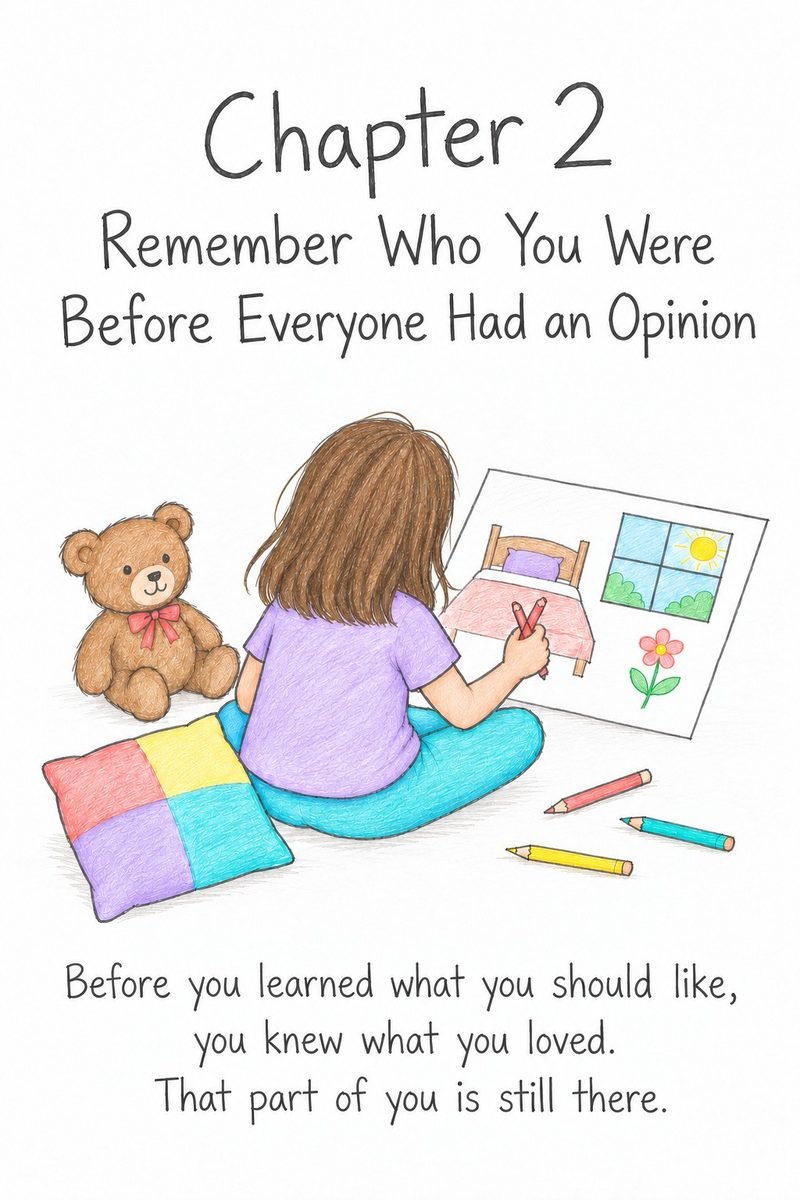
Chapter 2: Remember Who You Were Before Everyone Had an Opinion chapter card

When I was eight years old, I designed a room for the first time. It was the playroom under the stairs, the Harry Potter room from the introduction.

Nobody asked me to, and nobody showed me how. I just knew which color I wanted to see first when I walked in, where the desk should go, and which of my drawings belonged on the wall. I didn't know anything about interior design. I just knew when the room felt better.

You probably had opinions like that too, even if yours looked completely different from mine.

• • •

You Had Taste Before Anyone Taught You What Taste Was

Think about yourself as a kid. What colors did you reach for? What textures did you love? Did you build forts out of blankets or line your toys up perfectly? Did you want your room to be a jungle, a spaceship, a princess castle, a soccer shrine, or a secret hideout? Did you collect rocks, shells, stickers, ticket stubs, random tiny objects that made absolutely no sense to anyone else?

I'm not saying your eight-year-old self secretly knew your forever style. Kids change, and your taste should change too. But those early choices are worth looking at because they came from a version of you that was usually less worried about whether something looked cool.

Kids are brutally honest about what they like. They aren't checking whether a shade of purple is trending. They don't worry that a collection looks too weird for Instagram. If they love something, they want it where they can see it.

Before you knew there were supposed to be rules about "good taste," you just liked things. That's useful information.

That pull toward certain colors, textures, shapes, objects, and feelings is part of what I mean by design identity. It can change as you grow, obviously. But some of the patterns stick around, and they are useful clues.

• • •

The Great Editing

Here's what happens. You're a kid and you like what you like with almost no apology. Then, slowly, other opinions get louder.

A parent says that color is too much. A friend says something is weird. School gives you beige walls, fluorescent lights, and furniture nobody asked for. Social media shows you the same perfect rooms over and over until they start to look like the definition of good taste.

So you adjust. You pick the safer option. You buy the bedding everyone else has because at least you know it won't look stupid. You start wondering whether your own taste is wrong instead of just different.

Usually there isn't one dramatic moment where this happens. It's a bunch of tiny edits. By the time you're in high school or college, you can end up surrounded by things that are completely fine and still wonder why none of it feels very personal.

None of it is ugly. None of it is terrible. It is just kind of... not you.

That feeling is worth noticing.

My first big edit happened before kindergarten, and I only know about it from my family. We moved to Brazil when I was two and moved back two and a half years later, and by then Portuguese was the language I reached for first, even at home. Back in the United States, I stopped speaking it almost immediately. Nobody made me. I wanted to sound like the other kids at preschool, and apparently I was very determined about it. I still love the parts of Brazil that stayed in our house, the food, the soccer, the music, and I would like to get the language back someday. But I think about that four year old a lot. She traded something real for the feeling of blending in, and she didn't even have social media to blame.

• • •

What Younger You Already Knew

Think about a space you loved as a kid. Maybe it was your bedroom, a grandparent's house, a treehouse, a reading corner, the backyard, or even a friend's house you always wanted to stay at.

What did you like about being there? Maybe it felt cozy. Maybe you could be loud. Maybe everything had a place. Maybe it was colorful, private, sunny, messy, quiet, or full of people.

Write down three words for that feeling. Put them in your notes app if you want. Those words are useful because they tell you something about what your younger self responded to before you had design vocabulary for it.

The kid who loved color might still feel strange in an all-white room, even if that room looks perfect online. The kid who built blanket forts might still love enclosed, cozy spaces. The kid who arranged everything in perfect rows might still relax when a room has order.

Your childhood self didn't know more about design. They just weren't trying so hard to get the answer right.

• • •

The Lie of Growing Up

There's a weird idea that growing up means your taste is supposed to become more serious. You are supposed to want less color, fewer weird collections, and everything neutral and clean enough to belong in the same apartment tour. Every apartment tour is the same apartment. I think there is one apartment and they keep filming it.

Of course your taste changes. You probably don't want the exact room you wanted at eight. But the reason you loved something can survive long after the thing itself does. Maybe the dinosaur stickers were really about being obsessed with nature. Maybe the princess canopy was about softness and feeling protected. Maybe the wall covered in photos was about connection.

Growing up should give you more ways to express yourself, and it does. You get more choices now, so you might as well make some of them yours.

Think about the spaces you really love being in. Not necessarily the ones that would photograph best. The ones where you walk in and immediately learn something about the person who lives there. Those are usually the rooms I remember.

• • •

What You Loved Then Still Matters Now

I'm not saying you should recreate your childhood bedroom. I'm saying it might contain useful information.

If you loved bright color as a kid and everything you own now is gray because gray felt safer, pay attention to that. Maybe you genuinely love neutrals now. Or maybe you edited yourself more than you realized. Both answers are allowed.

If you loved collecting and displaying things but your shelves are empty because you decided minimalism was the only grown-up option, ask whether the empty shelf makes you feel better.

If you were happiest outside and your current room has nothing natural in it, maybe a plant, a piece of wood, a view of the sky, or even a nature photo would make it feel more like yours. One small natural element is enough to test the idea.

Your younger self doesn't get the final vote. But they might have left you some really good clues.

• • •

A Quick Exercise (Do This, Seriously)

Grab your phone. Open your notes app. Answer these five questions fast, before you start trying to give the "right" answer:

One: What was your favorite color as a kid?

Two: Describe a place where you felt happiest as a kid in three words.

Three: Did you like things organized, beautifully messy, or somewhere in between?

Four: What's one thing you loved having around that you don't have anymore?

Five: If eight-year-old you walked into your current room, what would they love first? What would they question?

Your answers are not a diagnosis or a rulebook. They're clues. When we get to the 12 Design Archetypes in Part Two, you can compare those early preferences with what you like now and see what still fits.

Next we're going to try a slightly weird idea I got obsessed with while researching this: can you use your surroundings to practice how you want to feel before the rest of your life is fully there yet?

That's where "fake it until you make it" gets a design version.

Chapter 3

Fake It Until You Make It (No, Really, This Is a Strategy)

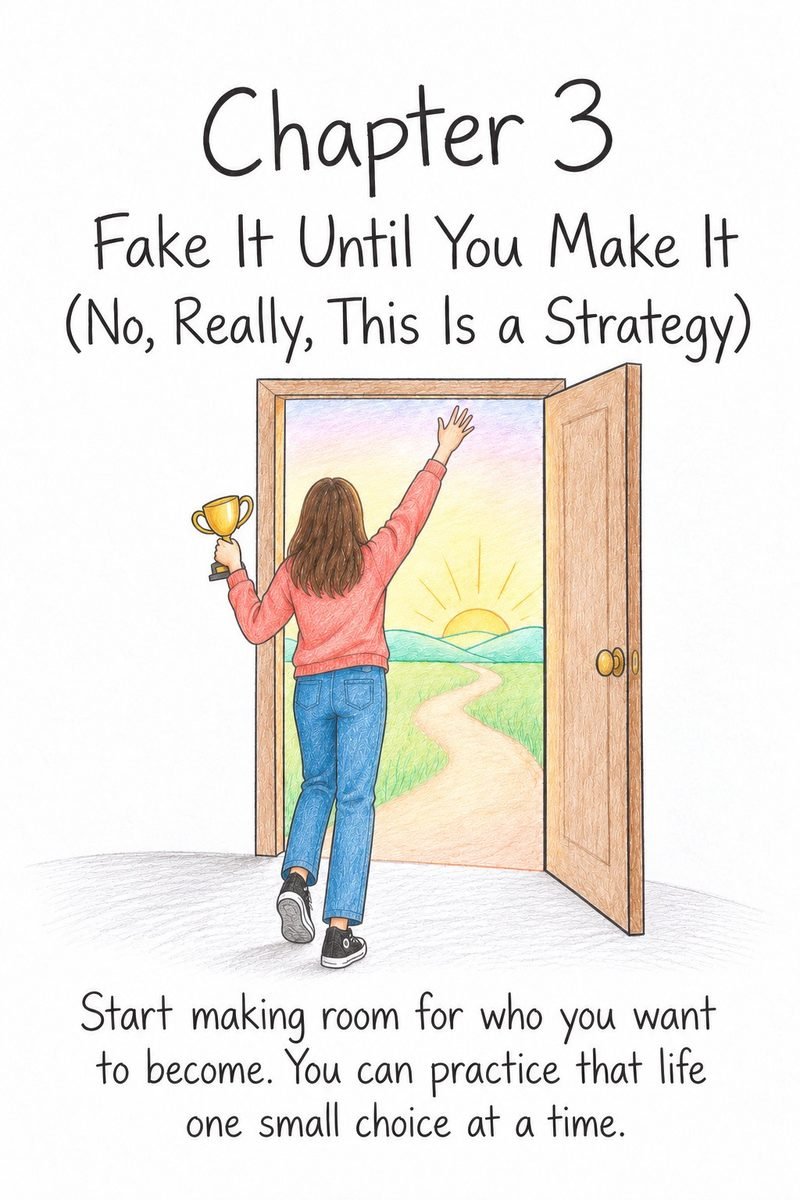
Chapter 3: Fake It Until You Make It (No, Really, This Is a Strategy) chapter card

There's a phrase people love to throw around: fake it till you make it.

Usually that means acting confident before you feel confident. Give the presentation even if your hands are shaking. Walk into the first day of a new job like you know where the printer is. Pretend you are less nervous than you are until, eventually, you really are less nervous.

In the fall of my senior year, my class went to the courthouse to practice how a bill becomes law, and I wore a black suit for the first time. It was a real blazer with real trousers, and it had shoulder pads. My mom grew up in the eighties, so the shoulder pads made her laugh.

I expected to feel like a kid playing dress up. Instead, I felt powerful. One of my teachers told me I looked like I could be his boss. I'm building a company of my own, so you can imagine how much I liked hearing that. I carried the compliment around for the rest of the day. I even caught myself standing straighter.

I'm five foot nine. Next time, I'm adding three inch heels so I'll be six feet tall and can look the men in a meeting right in the eye. The heels won't give me the experience to run a business. I'll have to earn that. But I liked getting a glimpse of the person I'm working toward. I left the courthouse wanting to feel that way again.

The suit changed how I carried myself for an afternoon, and it made me wonder whether a room could do a smaller version of the same thing.

I'm interested in a different version of it: using your surroundings to rehearse the feelings and habits you want more of before your life looks completely different.

That sounded a little ridiculous to me at first too. Then I started reading about how much our brains respond to cues from the spaces around us, and it made way more sense.

• • •

Your Brain Notices the Room

I used to think a room was mostly a backdrop. Then I started researching how light, clutter, sound, color, objects, and even where things are placed can affect attention, stress, memory, and mood. A room does not control you, but your brain is still taking it in.

The price tag part surprised me most: your brain does not care what anything cost.

It does not know whether the candle on your nightstand was five dollars or fifty, or whether the art on your wall came from a gallery, a thrift store, or a friend. What matters more is what your senses are taking in and what those things mean to you.

So if your room feels calm, easy to use, and personal, it may be easier to settle down, focus, or sleep. If everything you need is buried under piles and the lighting makes you want to leave, that adds friction before you have even started.

A messy room will not ruin your day, and a cute lamp will not fix your life. I wish. Your surroundings can still make certain feelings and behaviors easier or harder.

Your room cannot do your homework, make your decisions, or magically give you confidence. But it can make the next good choice a little easier to make.

That was the idea I kept circling while researching this chapter: environment is not destiny, but it is one of the cues around you all day. If you can change a few of those cues, that is worth knowing.

• • •

The Rehearsal Space

Think about actors for a second. Before a performance, they rehearse. They practice the lines, move through the scene, and get used to the space so it feels less unfamiliar when it counts.

You can do a small version of that in real life.

If you want schoolwork to feel less chaotic, make one place where the stuff you need is within reach. If you want to make more art, leave your sketchbook where you can see it. If you want friends to hang out, make the room feel like there is somewhere for them to sit.

You're not pretending you already have some perfect future life. You're giving yourself a setting that supports the thing you're trying to practice. That is what the suit did for me for an afternoon.

When I've redone my own room or helped a friend or family member rethink theirs, the changes that matter are usually not dramatic. A desk becomes easier to use. A corner feels calmer. Something they forgot they loved comes back out of a drawer. Small changes can make the whole room look different to you.

• • •

Six Things a Space Can Support

When I say design for the life you want, I am not talking about making your room look expensive so you can pretend you're rich. I mean thinking about what you want daily life to feel like and asking whether your space helps.

I kept coming back to six things while I was researching and writing this book: health, money, joy, connection, peace, and feeling like yourself. Design cannot create any of them by itself, but it can support the habits and feelings around them.

Health. Your room can support basics like sleep, movement, and getting out the door on time. Light, noise, temperature, clutter, and where you keep things can all affect how easy those routines feel. That is a lot more realistic than pretending a room can make you healthy. It can at least keep you from stepping on a charger at 2 a.m., which is close.

Money. A space cannot make you wealthy. It can, however, help you take better care of what you already own. Seeing what you have, using things instead of rebuying them, repairing something, borrowing, thrifting, and making a small budget go further are all design decisions too.

Joy. This one is simpler. Your room should contain at least a few things you genuinely like looking at. A color, a photo, a weird little thrift-store object, a blanket you love. Not everything needs a productivity purpose.

Connection. Spaces can make hanging out easier or more awkward. Two places to sit facing each other, enough light to see people's faces, somewhere to put a snack, or a floor cushion in a dorm can change how people use a room.

Peace. You cannot control everything happening outside your room, but you can learn what helps you come down from the day. Maybe that is softer lighting, less visual clutter, music, clean sheets, or five minutes when nobody needs anything from you.

Feeling like yourself. This is the part where your space belongs to you, not to an algorithm, your parents' taste, an old phase, or whatever everyone else is buying right now. You should be able to look around and recognize something of yourself there.

That is all I mean by designing for a fuller life. Your room will not hand you health, money, joy, connection, peace, or a sense of self. It can still make some of those things easier to practice.

• • •

You Don't Need a Big Budget

I know what you're thinking. Cool, Mia. I would love a room that supports all six of those things. My budget is approximately forty-seven dollars and my roommate leaves dishes in the sink.

That is fair. I'm seventeen. I am not working with an interior-design budget either, and I am definitely not asking you to buy a whole new life at Target. I've earned my own spending money since I was eleven, babysitting first, then dog sitting, then lifeguarding once I was old enough, so I know exactly how long it takes to earn $47.

A lot of the best changes cost little or nothing.

You can rearrange furniture, clear off a desk, swap what is on your walls, move a lamp, wash your bedding, organize the stuff you use, or put one meaningful object somewhere you will see it. If you want to spend a little, thrift stores, hand-me-downs, neighborhood groups, and secondhand marketplaces can stretch a small budget a lot further.

None of that is glamorous. I have never seen a dramatic before and after about moving a lamp. It can still make a room easier and nicer to live in.

Sometimes the move is as small as bringing a favorite photo out of your camera roll and printing it, moving a chair so you use it, or putting the art supplies you keep forgetting about on an open shelf. The change matters because it connects the room to your real life.

That is the rehearsal: not pretending the future already happened, but putting a few cues for the life you want into the space you have now.

• • •

What This Looks Like in Practice

Here are a few ways that can look in real life.

Want better sleep? Start with the bedroom basics. Clear enough space around the bed that getting in does not feel like an obstacle course. Charge your phone a little farther away if late-night scrolling is eating your sleep. Make the bed if that helps the room feel reset, and skip it if it does not.

Want to feel more settled? Unpack the box that has been sitting there for three months. Hang one thing you love. Use the mug or plate you keep saving for some imaginary better day. Treating your current space like it counts can make it feel less temporary, even if you know you will move again.

Want more creativity? Give your creative stuff somewhere visible to live. A sketchbook, guitar, camera, sewing basket, notebook, whatever your thing is. If getting to it requires moving six other things first, you are less likely to use it.

Want more connection? Make one spot where another person can comfortably exist. In a dorm, that might be a floor cushion. In a bedroom, maybe it is clearing the chair that currently holds seventeen hoodies. Tiny spaces can still say, sit here.

Want more calm? Look at what your eyes hit first when you enter the room. If it is a pile that stresses you out, deal with that pile before you buy a single new thing. Softer light can help too, especially at night.

You can make a room work better and feel more like you on almost no money.

• • •

The Feeling Comes First

Researchers use the term embodied cognition for the idea that thinking is connected to what our bodies are doing and perceiving. I like it because it pushes against the idea that your mind is somehow separate from the physical world around you.

It is not a neat formula where room equals mood equals life. There are way too many variables for that. A more realistic takeaway is that physical surroundings can be one part of how a moment feels.

Which is useful, because your surroundings are one of the things you can sometimes change right now.

You do not have to wait until you have the perfect job, apartment, body, relationship, or bank account to make your current space support you better. You can start before any of that is figured out.

This is not pretending everything is amazing when it is not. If life is hard, changing your lamp does not erase that. It can still make one corner of the day feel better.

That is enough. Design does not have to solve your whole life to be worth doing.

You're not faking a life. You're trying a setup and seeing whether it helps.

• • •

One More Thing Before We Move On

Everything in this chapter applies to more than your bedroom. It can show up in what you wear, where you study, what is on your phone, the music you play, the way you eat with people, and the routines that make up a normal Tuesday. We'll get into all of that in Part Three.

For now, remember this: you do not have to wait for your life to get better before your surroundings get better. Sometimes improving the surroundings is one small way to make the rest easier.

Start small. Use what you have.

Seriously, one thing is enough.

Next we need to talk about the stuff that belongs to an older version of you, because sometimes the hardest part of changing a space is admitting that something does not fit anymore.

Next comes the garden metaphor.